

Multi-Agent ERP in Manufacturing is moving from concept to operational reality. Most enterprise software teams spent 2024 and 2025 exploring what AI could do. In 2026, the question has changed: what is AI already doing inside your ERP — and what is it doing without waiting for someone to ask?
The shift from AI assistants to AI agents in ERP manufacturing marks a meaningful inflection point. Copilot-style tools suggest, recommend, and summarize. Agents act. They read supplier emails, detect stock risks, reschedule disrupted production lines, and process incoming shipments — executing transactions directly inside Dynamics 365 F&O before a human even opens their inbox.
This article examines what agentic ERP looks like in practice, using real capabilities already deployed on D365 F&O. No roadmaps, no speculation — only what is running today.
The Three Stages of ERP Intelligence
ERP systems have passed through two distinct phases and are now entering a third.
Stage 1 — Manual ERP: Users navigate the system, enter data, generate reports, and make decisions. The ERP records what happened. Every insight requires a human query; every action requires a human keystroke.
Stage 2 — Assisted ERP (Copilot): AI surfaces recommendations, drafts responses, and summarizes data on request. The human still decides and executes. Copilot reduces effort but does not eliminate the human decision loop.
Stage 3 — Agentic ERP: AI agents monitor conditions continuously, identify exceptions, evaluate options within defined boundaries, and execute transactions — escalating only when a decision requires human judgment. The ERP no longer waits to be asked.
For manufacturing operations, the difference between Stage 2 and Stage 3 is not incremental. A Copilot that recommends rescheduling a production order after a machine breakdown still requires a planner to open D365, review the recommendation, and execute the change. An agent detects the breakdown, analyzes the dependency chain, reschedules the affected orders, and sends a confirmation — in minutes, not hours.
What AI Multi-Agent ERP in Manufacturing Actually Does
The term “AI agent” is broad enough to mean almost anything. In the context of AI agents in ERP manufacturing, it refers specifically to software components that:
- Perceive — continuously read data from ERP, email systems, documents, or connected data sources
- Reason — apply logic, classification, or language models to interpret what they observe
- Act — execute transactions, generate records, send communications, or flag exceptions inside D365 F&O
- Escalate — route decisions requiring human judgment to the appropriate person, with full context
What distinguishes this from workflow automation (Power Automate, for example) is the reasoning layer. A workflow fires when a condition is met. An agent interprets unstructured input — a supplier email, a packing list PDF, a verbal work description — and determines what action the ERP should take. That gap between structured trigger and unstructured input is where AI agents operate.
5 Agents Already Running on D365 F&O — and How They Work Together
The following capabilities are live on Dynamics 365 Supply Chain Management and D365 F&O as part of YVS’s agentic ERP framework. Each addresses a workflow where manual execution creates measurable operational risk, and each is designed to share context with the others, not operate in isolation.
1. Procurement Intelligence — Supplier Communication Agent
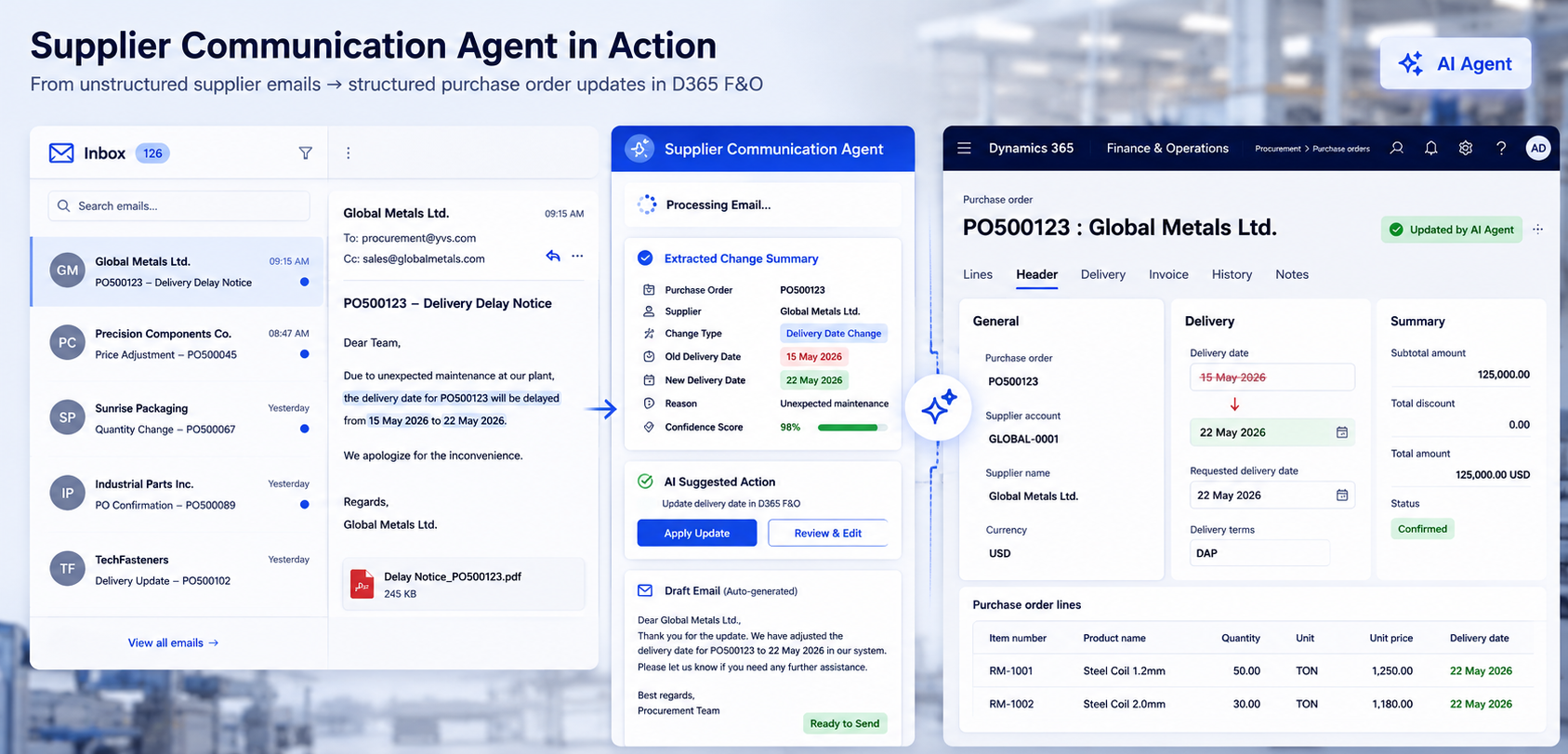
Procurement teams in mid-to-large manufacturing operations receive between 50 and 200 supplier emails daily. These contain delivery delays, price adjustments, quantity changes, and order confirmations — all in unstructured text, across multiple formats and languages. Every message that requires manual reading, interpretation, and ERP update is a compounding risk: delays accumulate, changes get missed, and planners spend cognitive effort on data entry instead of supplier strategy.
The Supplier Communication Agent addresses this through end-to-end procurement intelligence. It reads incoming supplier emails, identifies purchase order intent, and automatically detects changes — whether a shift in delivery date, a quantity discrepancy, or a price update — extracting the relevant data and generating a structured change summary with suggested ERP updates. For purchase orders that remain unconfirmed or pending, the agent drafts and sends follow-up emails autonomously, ensuring no open PO goes untracked. When a confirmed change carries downstream risk — a delayed delivery that affects production scheduling, for example — the agent flags it for immediate planner review with full context already attached.
The result: procurement teams that once spent 2–4 hours a day reading supplier emails and updating the ERP can hand that work to the agent — freeing up roughly 10–20 hours every week. Errors from manual interpretation — misread quantities, overlooked date changes, missed follow-ups on open POs — are eliminated at the point of intake. Procurement teams shift from managing email volume to managing supplier relationships.
2. Production Resilience — Production Order Rescheduling Agent
Machine breakdowns are inevitable in manufacturing. The operational problem is not the breakdown itself — it is what happens in the hours that follow. Every disrupted production order creates a cascade: dependent orders must be re-evaluated, routing sequences must be revalidated, capacity constraints must be rebalanced, and downstream commitments must be assessed — all manually, all under time pressure, all while the planner is already managing other priorities.
The Production Order Rescheduling Agent handles this cascade automatically. When downtime is detected, the agent identifies the affected asset, maps the full dependency chain across all related production orders, evaluates capacity constraints and routing sequences, and executes constraint-based rescheduling directly in D365 F&O via MCP integration. It does not simply move dates — it validates that each rescheduled order remains feasible within the available capacity window and the commitments already in place. Conflicts it cannot resolve autonomously — orders requiring a human trade-off decision — are routed to planners with the full dependency map already prepared.
This cuts recovery time from several hours to minutes. Planners shift from reactive data entry — manually re-sequencing orders under pressure — to reviewing the exception cases that genuinely require their judgment. Production resilience becomes a systematic capability, not a function of how quickly a planner can respond.
3. Proactive Out-of-Stock Agent
Traditional ERP inventory monitoring is reactive: a stock-out is discovered when an order cannot be fulfilled. The Proactive Out-of-Stock Agent changes that model.
The agent continuously monitors inventory levels across all SKUs and warehouse locations without requiring manual report exports. It automatically categorizes items into three risk levels — negative inventory (overselling already occurring), zero stock (out-of-stock), and low-stock warnings — and sends ranked alert emails directly to warehouse managers.
For food and beverage manufacturers with high-velocity, perishable SKUs, this shift from reactive to proactive inventory management is particularly impactful. Items that expire cannot be over-ordered to compensate for late detection. Early warning is the only protection.
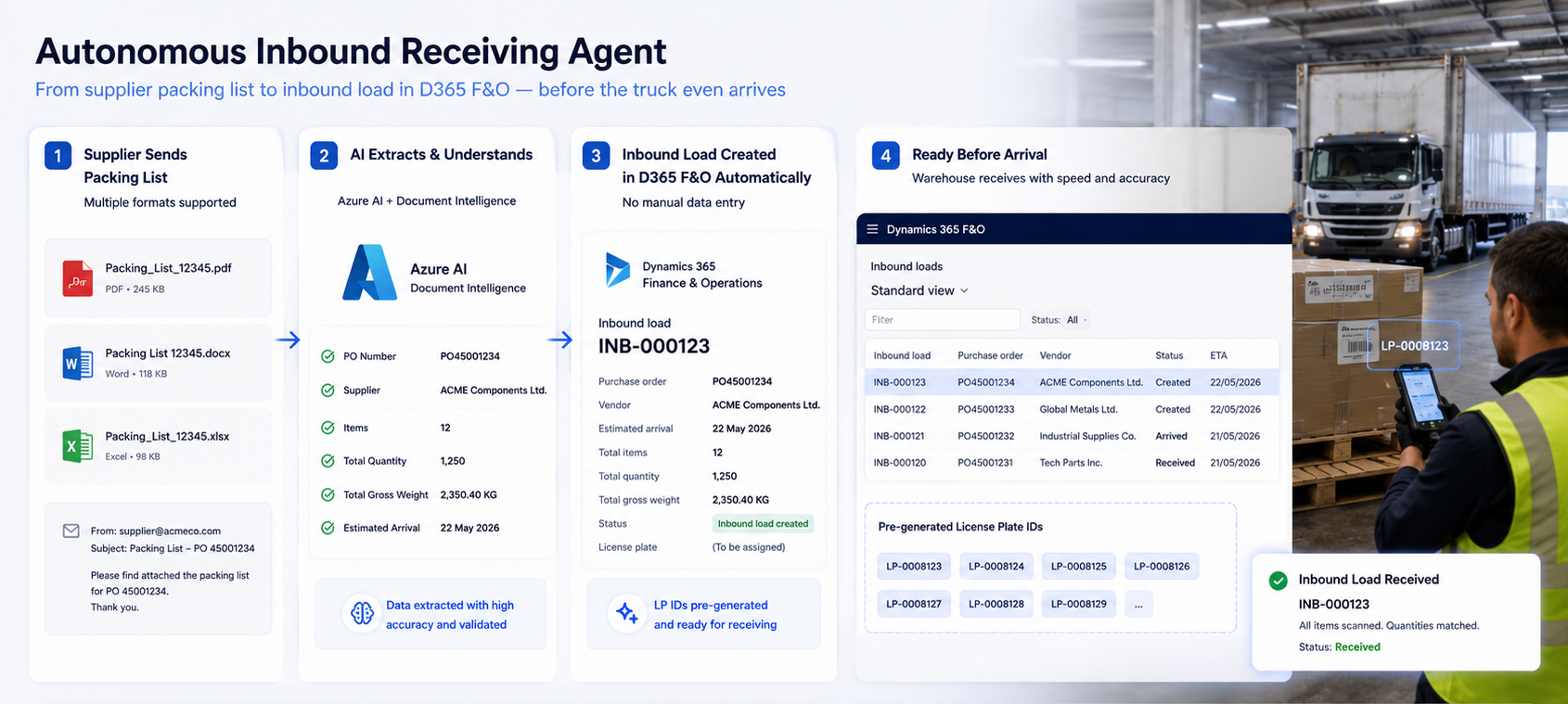
4. Warehouse Readiness & Traceability — Autonomous Inbound Receiving Agent
Supplier packing lists arrive in PDF, Excel, and Word formats — none of them structured the same way. Manual data entry from packing lists into ERP is one of the most error-prone processes in warehouse operations, and one that creates no strategic value.
The Autonomous Inbound Receiving Agent uses Azure AI document intelligence to extract data from unstructured packing lists, standardize it, and apply confidence scoring with human-in-the-loop fallback for low-confidence extractions. Before the delivery truck arrives, the agent has already created the inbound load record and license plate IDs in D365 F&O. When the truck arrives, warehouse staff scan the pre-generated license plate to confirm — nothing more. Batch-level and lot-level traceability is established at the point of receipt, not reconstructed retroactively, creating a clean audit trail from the moment goods enter the facility.
Receiving collapses from line-by-line manual data entry into a single confirmation scan. Beyond speed, the agent provides a foundation for warehouse-wide stock accuracy: because every received item is correctly recorded and traceable from intake, the Proactive Out-of-Stock Agent can monitor true on-hand positions with confidence — not estimates based on delayed or incomplete entries. The two agents work together to ensure that what enters the warehouse is immediately visible, accurately tracked, and actively monitored. This capability connects directly with YVS’s AI Warehouse Optimization (WHO), which applies slotting intelligence after items enter the warehouse.
5. Inventory Assistant Agent
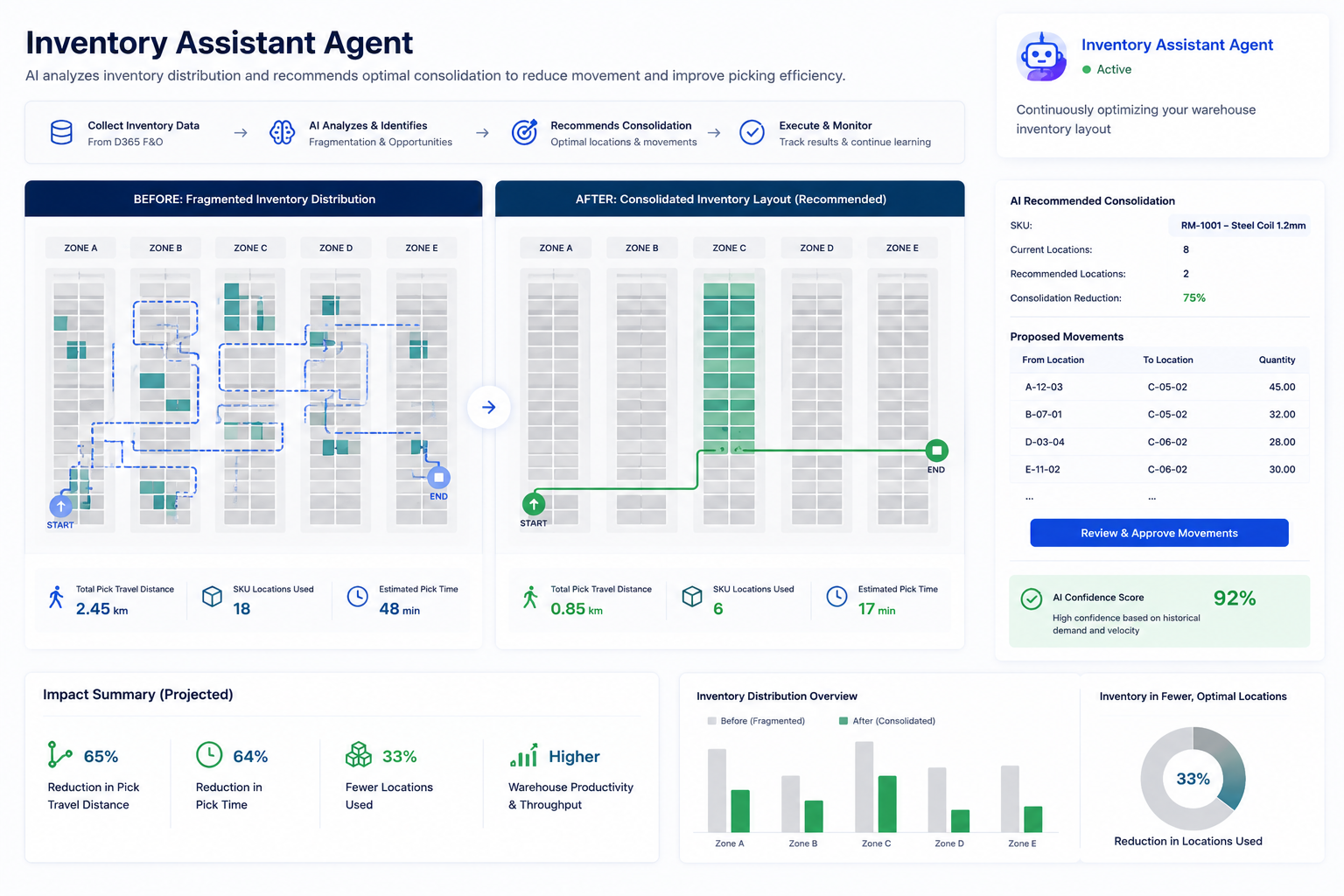
Warehouse inventory spreads across locations over time. SKUs fragment across zones, reducing pick efficiency and obscuring true stock levels. The Inventory Assistant Agent addresses this not as a periodic cleanup task, but as a continuous optimization process. It analyzes item distribution across warehouse zones, identifies fragmentation patterns, and generates consolidation recommendations — specifying which items to move, where, and in what quantity, while protecting reserved stock from displacement. Over time, the agent learns from movement patterns to refine its recommendations, improving pick efficiency and reducing the planning burden of manual audits.
Within the multi-agent framework, the Inventory Assistant Agent plays a distinct role: it is not triggered by an exception, but runs continuously in the background — representing the shift from reactive automation to proactive, always-on optimization.
The Architecture Behind Agentic ERP
All five agents run on a shared technical foundation: D365 F&O as the system of record, Azure AI for document intelligence and language processing, Copilot Studio for agent orchestration, and MCP (Model Context Protocol) for ERP transaction execution.
This architecture matters for two reasons. First, agents do not operate on a separate data layer — they read from and write to the same D365 environment that the rest of the organization uses. There is no parallel database to synchronize, no integration middleware to maintain. Second, because agents execute through D365’s standard transaction layer, every action is subject to the same role-based access controls, approval workflows, and audit logging that governs human users. The Microsoft 2026 Release Wave documentation outlines how Microsoft’s own agentic AI capabilities extend this foundation further.
Governance: What Keeps Agents in Bounds
A recurring concern with autonomous ERP operations is control — and it is a legitimate one. In a multi-agent system, where several agents may be acting concurrently across procurement, production, and warehouse domains, the question of accountability becomes more important, not less. If agents are executing transactions, who is responsible for the outcome? What prevents an error in one agent from propagating across the chain? And how does a compliance team verify what happened?
YVS’s agentic ERP framework addresses this through three mechanisms:
- Role-based access: Agents inherit the permission boundaries of the roles they operate within. An agent cannot approve a purchase order, modify a BOM, or access financial data outside its defined scope — regardless of what it processes.
- Human-in-the-loop escalation: Decisions that exceed defined confidence thresholds or involve conflicts the agent cannot resolve are routed to the appropriate human with full context. The agent does not guess; it stops and asks.
- Full audit trail: Every agent action is logged in D365 F&O as a standard transaction record — indistinguishable from a human-executed transaction for audit purposes. Compliance and traceability requirements are met by default.
This governance model is why multi-agent ERP is a practical enterprise capability, not an experimental one. Operational trust in agentic ERP is not built on confidence in AI judgment — it is built on clearly defined boundaries, mandatory escalation for ambiguous decisions, and a complete record of every action taken. The system does not require blind trust; it requires AI to handle the high-volume, low-ambiguity work reliably and transparently, so humans can focus on the decisions that genuinely need them.
Real-World Impact: Lifetime Products on Dynamics 365
After modernizing on Microsoft Dynamics 365, Lifetime deployed two production-ready agents natively inside its ERP:
- Supplier Communications Agent: autonomously communicates with suppliers to proactively mitigate order delays and supply chain disruptions.
- Account Reconciliation Agent: automates matching and clearing of transactions between subledgers and the general ledger.
Two months after deployment, the results were unambiguous:
| Metric | Impact |
|---|---|
| E-commerce order processing capacity | 95% increase |
| Knowledge workforce rebalanced to higher-value tasks | 20% |
| Master planning cycle time | 24 hours → 15 minutes |
“With Supplier Communications Agent in Dynamics 365, we’re giving our people the tools they need to continue to make an impact on the company and better compete in the marketplace.”
— Ted Esplin, COO, Lifetime Products
The takeaway for manufacturers: agents deliver measurable ROI when deployed on a modernized ERP foundation, scoped to high-volume rules-based workflows, and framed as capacity multipliers — not headcount reductions. Lifetime did not cut jobs; it redirected 20% of knowledge work into product innovation and customer experience.
From Agents to Chains: The Multi-Agent Direction in Manufacturing ERP
The five agents described above each address discrete, high-frequency workflows. But the more significant development — and the direction Microsoft is actively building toward — is what happens when multiple agents operate in coordinated chains rather than as isolated components.
The next step is moving from individual agents toward coordinated agent chains — where the output of one agent becomes the input for the next, enabling end-to-end workflows that span procurement, production, and warehouse operations without manual handoffs. This is the direction Microsoft is actively building toward, and it is the framework YVS is developing under the concept of Multi-chain in Manufacturing. More on this in an upcoming article.
What This Means for Your Operations
Multi-agent ERP in manufacturing is not a future capability to evaluate on a roadmap. It is operational today, addressing the workflows — supplier communications, production rescheduling, inventory monitoring, inbound receiving — where manual execution creates the most measurable risk. And the foundation being built now is the same one that will support coordinated multi-chain operations as the capability matures.
The question for manufacturing leaders is not whether agentic ERP will affect their operations. It is which workflows to address first — and whether their current ERP foundation is capable of supporting not just individual agents, but the coordinated, multi-agent architecture that delivers compounding operational value over time.
Explore how YVS approaches multi-agent ERP on Dynamics 365 F&O or connect with our team to discuss what this looks like for your manufacturing environment.