

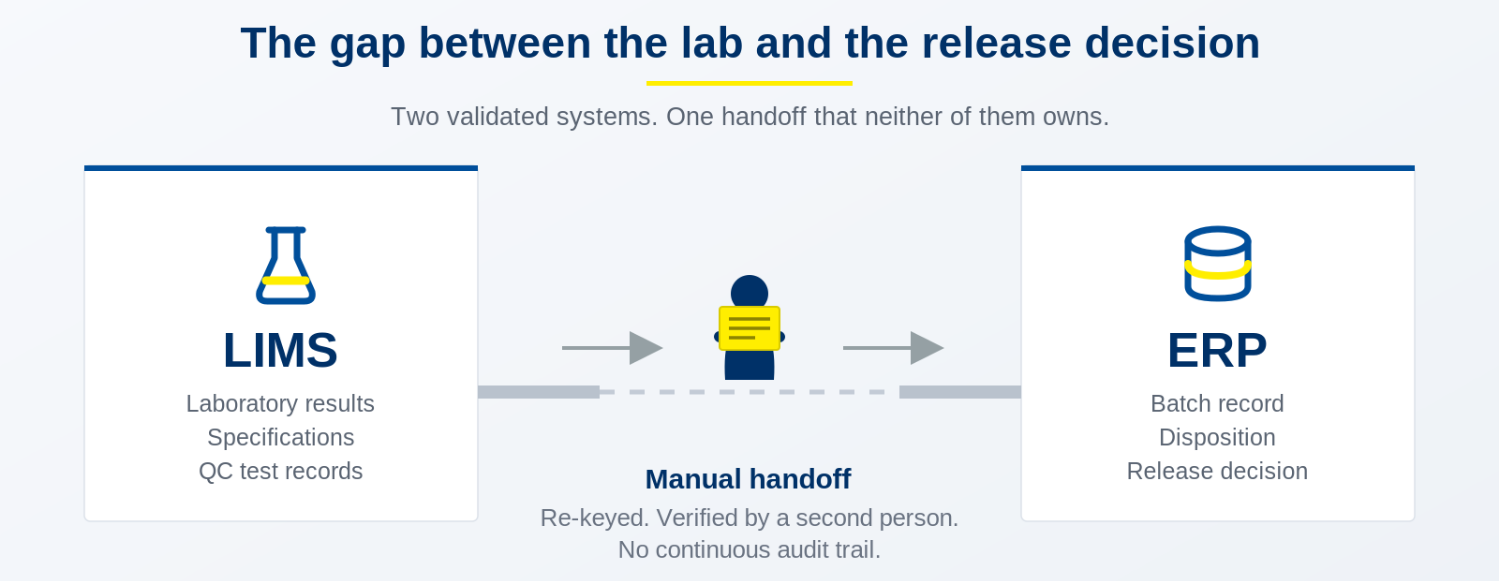
Your QC result is in LIMS. Your batch release happens in the ERP. In plants where LIMS ERP integration is manual or partial, the space between those two systems is where release time quietly disappears.
It rarely looks like a problem. The testing was done on schedule. The result was within specification. The batch is sitting in quarantine, finished, waiting. And yet release does not happen today, because someone still has to move that result from one system into another, and someone else has to confirm they moved it correctly.
Nothing failed. The process is simply waiting on a handoff that no system owns.
What the integration gap actually looks like
|
Level |
What the release path looks like |
What it costs you |
|
0 — Paper bridge |
QC results are printed or transcribed by hand, then verified by a second person. |
Release waits on people being available. The evidence chain has a segment no system recorded. |
|
1 — File bridge |
Results are exported from LIMS and attached to the ERP record, often as PDF or spreadsheet. |
Faster, but the ERP holds a copy rather than the source. Provenance must be explained, not shown. c |
|
2 — Interfaced |
A scheduled interface moves results between systems. Out-of-spec results are still handled manually. |
Routine batches flow. The difficult ones — the ones that matter most — fall back to manual handling. |
|
3 — Connected |
QC results land in the system of record as source data. Disposition references the original, exceptions included. |
Release waits on the decision, not on the data. The audit trail is continuous end to end. |
Why weak LIMS ERP integration is a compliance problem, not just a speed problem
Manual transfer between two validated systems creates a link in the evidence chain that neither system fully owns.
Consider what an inspector is actually asking when they follow a result through to release. Where did this number originate? Who moved it? Was it transcribed accurately? What would have happened if it had been entered incorrectly? In a connected flow, the system answers those questions. In a manual flow, a person answers them — usually correctly, but from memory, procedure and a second-person check rather than from a continuous record.
This distinction is becoming more consequential. The draft revision of EU GMP Annex 11, published in July 2025 by the European Commission together with PIC/S, expands the guideline from roughly five pages to nineteen and shifts its centre of gravity toward security, identity and access management, and audit trails. Audit trails are now among the most heavily weighted topics in the document, with expectations that they cannot be disabled by ordinary users and that they are reviewed on a risk basis rather than merely enabled.
For manufacturers in ASEAN, this is not a distant European matter. The draft was prepared jointly with PIC/S, and PIC/S GMP is the framework many regional manufacturers already operate under. A manual step in the middle of a release decision is exactly the kind of control gap that a more audit-trail-focused inspection will surface.
Every industry has integration gaps. Life sciences end differently
Disconnected systems are not unique to pharmaceutical manufacturing. Almost every manufacturer has data sitting in one platform that someone re-keys into another. What makes this particular gap different is what sits at the end of it.
In most industries, the consequence of a broken integration is a delay, a reconciliation task, or a reporting error. In pharmaceutical and life sciences manufacturing, the consequence is a batch release decision — a formal determination that a medicinal product is fit to reach patients. In markets that require it, a Qualified Person signs that determination personally and carries individual accountability for it.
That changes the nature of the requirement. A QP is not simply asking whether the result was within specification. They are asking whether the evidence supporting that conclusion is complete, attributable and intact. When the evidence has been assembled across a manual bridge between two systems, the answer depends on the quality of the bridge — and the bridge is the one part of the chain that was never validated as a system.
It is also the part that behaves worst under pressure. Manual steps hold up well when volume is steady and the people doing them are experienced. They degrade when three batches land at once, when someone is on leave, or when a new market adds documentation requirements nobody has worked with before.

What changes when LIMS and the ERP are connected
When QC results flow directly from the laboratory system into the system of record, three things change at once.
- The result arrives with its own provenance. Where it came from, when, and against which specification is carried with the data rather than reconstructed afterwards.
- Disposition is made against source data. The release decision references the original result, not a copy of it, which removes the transcription question entirely.
- The audit trail is continuous. There is no segment of the evidence chain that exists only in a person’s recollection of what they did and when.
Conditional release also becomes workable rather than risky. When a Qualified Person can release a batch conditionally with full visibility of what is outstanding and what has been confirmed, the decision is made with information rather than despite the lack of it.
None of this removes human judgment from release, and it should not. What it removes is the administrative work surrounding that judgment — the retrieving, re-keying and cross-checking that consumes reviewer time without improving the quality of the decision.
How Yokogawa Votiva Solutions approaches LIMS ERP integration
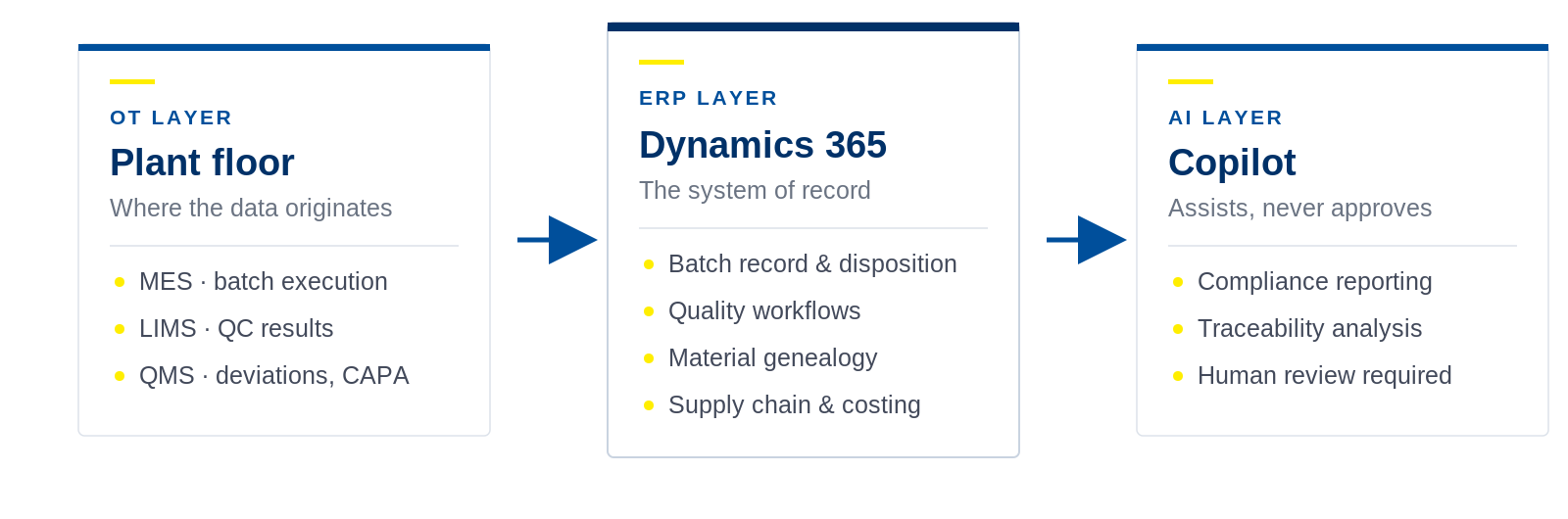
Closing this gap is not primarily an ERP problem, which is why ERP vendors often struggle with it. It requires reaching into the plant-floor systems where the data originates.
Yokogawa Votiva Solutions (YVS) builds this connection as part of a pharmaceutical manufacturing ERP implementation. MES, LIMS and QMS are connected to a Microsoft Dynamics 365 Finance & Supply Chain Management core, so execution and quality data flow into the system of record rather than sitting alongside it. The capability comes from Yokogawa’s background in Pharmaceutical industry and process automation — an operational technology heritage most business-application partners do not have.
We are also direct about what this is. It is not a pre-packaged pharmaceutical product. It is Dynamics 365 configured for regulated manufacturing, integrated with the plant floor, and implemented by a team that has done it repeatedly in this region.
Find out where your release path breaks
If release regularly waits on data movement rather than on testing, the useful first question is not which software to evaluate. It is which handoffs in your current release path have no system of record behind them — and which of those will break first as volume or market scope grows.
That is a question you can answer in an afternoon with the right people in the room: walk one recent batch from sample to disposition and mark every point where a person carried data between systems. The marks are your gap.
Book a complimentary Pharma & Life Sciences ERP Readiness Assessment with YVS.